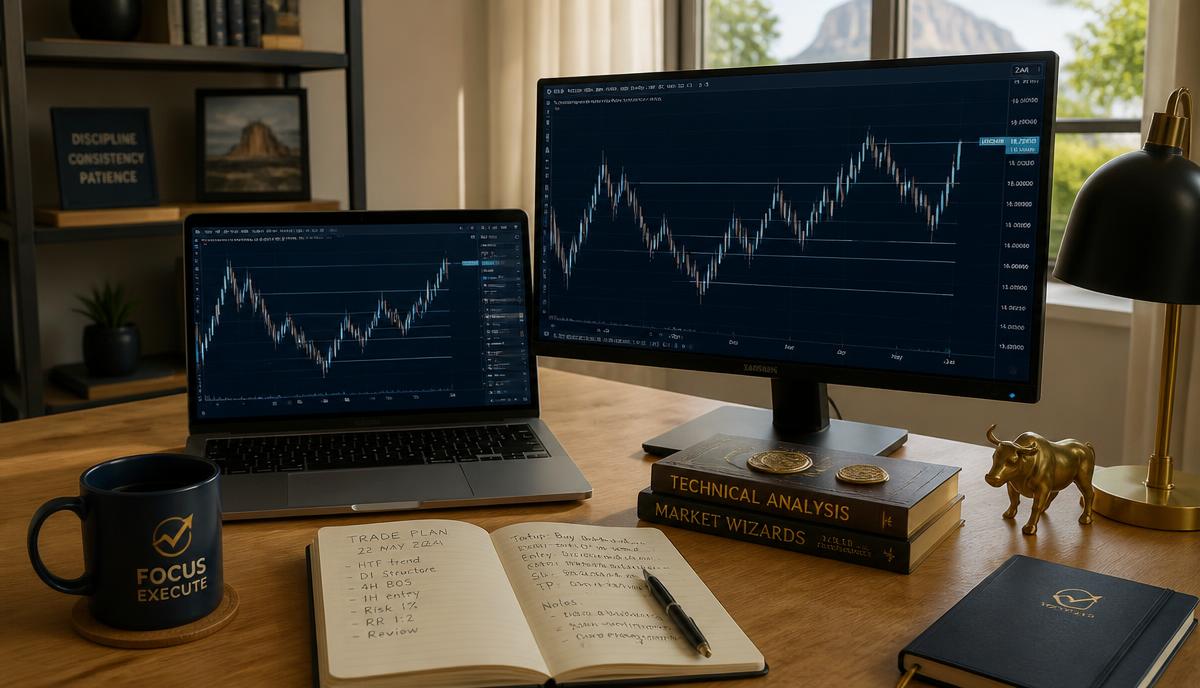
How Much Money Do You Actually Need to Start Forex Trading?

One of the biggest questions beginners ask is:
"How much money do I need to start forex trading?"
And very often, the amount they think they need is much higher than what is actually necessary.
Many people believe they need thousands of dollars before they can start trading properly. Others start with a very small amount and expect to turn it into a large account quickly. Both approaches can create problems.
The truth is this:
You do not need a huge amount of money to start learning forex trading properly. But you do need the right mindset, the right expectations, and a conservative approach.
If you are a beginner, or if you have tried trading before and lost money, this article will help you understand what is realistic, what is dangerous, and how to start properly.
The Biggest Mistake Beginners Make About Starting Capital
The biggest mistake people make is thinking they need a lot more money to start trading than they really do.
This belief can hold people back for months or even years. They wait until they have "enough money" before they start learning properly. But trading is not only about capital. It is about discipline, confidence, risk management, emotional control, and having a tested strategy.
A beginner does not need a large account to start learning these things.
In fact, starting too big can sometimes be dangerous.
When a beginner starts with too much money and does not yet understand risk, emotions, or strategy, the losses can be much more painful. The pressure becomes higher, the emotional decisions become stronger, and the account can disappear quickly.
The goal in the beginning is not to become rich. The goal is to learn how to trade properly.
So, What Is a Sensible Amount to Start With?
A sensible recommended amount for a beginner is around $500.
Can you start with less? Yes, you can.
But $500 is a good starting point because it gives you enough room to practise live trading with real emotions involved, without needing to risk a large amount of money.
The important thing is to understand what the $500 account is for.
- It is not there to replace your salary.
- It is not there to make you rich in one month.
- It is not there to recover previous losses quickly.
- It is there to help you learn.
A $500 account gives a beginner the opportunity to practise trading in a real environment where emotions are involved. Demo trading is helpful, but it does not always create the same emotional response as real money.
Even a small live account can teach you how you behave when a trade goes against you, when you are tempted to overtrade, or when you want to move your stop loss.
That is where real learning starts.
What Should Your Goal Be With a $500 Trading Account?
When someone starts with around $500, the first goal should not be income.
The first goal should be:
Learning Discipline
Discipline is one of the most important skills in trading.
- Can you follow your rules?
- Can you wait for your setup?
- Can you avoid revenge trading?
- Can you stop trading when your plan says stop?
These are the skills that matter in the beginning.
Building Confidence
Confidence does not come from one lucky winning trade.
Confidence comes from repeating a tested process, following your plan, and seeing that you can make good decisions even when the market is moving.
A beginner must build confidence slowly.
Testing a Strategy
Your strategy needs to be tested.
You need to know whether your trading approach makes sense, whether it suits your personality, and whether you can follow it consistently.
This is why starting with a smaller live account can be useful. It gives you the chance to test your strategy under real conditions without putting unnecessary pressure on yourself.
What Risk Rule Should a Beginner Follow?
A beginner should work conservatively.
A good approach is to focus on trades where the potential reward is greater than the risk. For example, a 1:2 risk-to-reward ratio means that for every amount you risk, your potential target is twice that amount.
- If you risk $5, your target would be $10.
- If you risk $10, your target would be $20.
This does not mean every trade will win. It simply means you are learning to think in terms of structure and risk, not emotion.
Beginners often focus only on how much they can make. But the better question is:
How much am I willing to risk to find out if this trade idea is right?
That shift in thinking is important.
Trading is not about being right all the time. It is about managing risk properly when you are wrong and allowing good trades to play out when you are right.
Should Beginners Start on Demo or Live?
Demo accounts can be useful, but they must be used correctly.
One problem with demo accounts is that they often come with a large balance, such as $10,000 or more. For a beginner, that can create the wrong mindset.
Instead of practising responsibly, beginners often throw themselves at the big demo balance. They take trades they would never take with real money. They use lot sizes that are unrealistic. They become careless because there is no emotional consequence.
That is not proper practice.
If you are using a demo account, you should treat it as if it were your real starting capital.
If you plan to start live with $500, then practise as if you only have $500. Trade conservatively. Use realistic position sizes. Follow the same rules you would follow with real money.
Demo trading should help you build discipline, not bad habits.
A small live account can then help you experience the emotional side of trading. But again, the goal is not to make quick money. The goal is to learn how you behave when real money is involved.
Realistic Expectations: Why Making $10 Can Be Progress
One of the most damaging things in trading is unrealistic expectations.
Unrealistic trading expectations kill trading.
A beginner may start with $500 and expect to make hundreds or thousands of dollars quickly. When that does not happen, they become frustrated. They increase risk. They overtrade. They try to force the market to give them results.
That is usually where the damage happens.
If you are starting with a small account, making $10 can be progress.
That may sound small, but it is not about the dollar amount in the beginning. It is about what that $10 represents.
- Did you follow your plan?
- Did you wait for your setup?
- Did you manage your risk?
- Did you avoid emotional decisions?
- Did you close the trade according to your rules?
If yes, that is progress.
Small wins matter because they build proof that you can follow a process.
A beginner needs patience. Trading is not something you rush. You must give yourself time to develop the skill.
Forex Trading Is Not a Get-Rich-Quick Scheme
Anyone starting forex trading because they want to make money quickly needs to understand this clearly:
Forex trading is not a get-rich-quick scheme.
This is especially important for people who are under financial pressure or trying to recover money they have already lost.
When people trade from pressure, they often make poor decisions. They risk too much. They enter too many trades. They chase losses. They look for shortcuts.
But trading does not reward desperation.
Trading requires structure, discipline, patience, and emotional control.
If you need money urgently, trading is not the place to try and solve that problem quickly. The market does not know your financial situation, and it will not adjust itself to your needs.
You must approach trading as a skill that takes time to build.
What About Bonuses, High Leverage, and Small Deposits?
Bonuses and small deposits can assist when capital is small.
They can give a beginner more room to practise, especially when starting with limited funds. But they must be used carefully.
High leverage is risky.
Leverage can make profits look attractive, but it can also increase losses very quickly. Beginners often focus on how leverage can help them grow an account, but they do not always understand how quickly it can work against them.
The rule is simple:
Learn before utilising.
Do not use high leverage just because it is available. Do not use a bonus as an excuse to trade recklessly. Do not think a small deposit means you can gamble because "it is not much money."
The habits you build on a small account are the habits you will carry into a larger account. If you cannot manage risk properly with $100, you will not suddenly manage it properly with $10,000.
If you trade irresponsibly with $100, you are likely to trade irresponsibly with $1,000 or $10,000.
Start properly from the beginning.
The Psychology of Trading Is Underestimated
One of the most underestimated parts of trading is psychology.
Many beginners focus only on the strategy. They want the perfect setup, the perfect indicator, or the perfect entry. But even a good strategy can fail if the trader cannot manage their emotions.
Fear, greed, impatience, revenge trading, overconfidence, and frustration can destroy an account.
That is why a beginner must work on psychology from the start.
- You need to learn how you react when you lose.
- You need to learn how you behave after a win.
- You need to learn whether you can sit on your hands and wait.
- You need to learn whether you can accept being wrong.
Trading is not only a technical skill. It is also a mental skill.
Work on it. Apply yourself.
Starting Properly Matters More Than Starting Big
The amount of money you start with is important, but it is not the most important thing.
Starting properly matters more.
A beginner with $500, realistic expectations, and good discipline is in a better position than someone with a large account and no control.
The first phase of trading should be about learning how to trade properly. It should be about building confidence, testing your strategy, managing risk, and understanding your own psychology.
Do not rush the process.
- If you make $10 and followed your plan, that is progress.
- If you avoided a bad trade, that is progress.
- If you stopped yourself from revenge trading, that is progress.
- If you kept your risk small, that is progress.
Trading success is built through small, repeated, disciplined actions.
Final Thoughts
So, how much money do you actually need to start forex trading?
You can start with less, but around $500 is a sensible recommended amount for a beginner who wants to practise properly with real emotions involved.
But remember, the goal is not to get rich quickly.
The goal is to learn discipline, build confidence, test your strategy, and understand risk.
- Start small.
- Trade conservatively.
- Be patient.
- Respect leverage.
- Work on your psychology.
- And treat every trade as part of your education.
Forex trading is not a shortcut. But if you start properly, apply yourself, and manage your expectations, you give yourself a much better chance of building the skill the right way.
Building this skill the right way starts with knowing exactly where you stand today. Take five minutes for an honest self-assessment with Find Your Level to see which stage of the trading journey you are genuinely in. From there, move to Compare Courses to see which training programme matches your current phase and capital goals. Mastery is built through deliberate practice, not downloaded overnight. But when you build it on the right educational path, the timeline to consistency is much shorter than you think.
Once you know what you can safely fund an account with, the next decision is style: read swing trading vs scalping vs day trading to work out which approach fits your schedule and temperament.