The Truth About Prop Firm Challenges: Why Most Traders Fail

Prop firm challenges have changed retail trading. For the first time, a trader with a 100 USD evaluation fee can access a 25,000 USD account — and recurring monthly payouts if they pass.
The catch: roughly 9 out of 10 traders fail their first challenge. Not because the rules are unfair, but because most traders approach a challenge the same way they approach their own account, and the same way they approach their own account is usually what blew up their last one.
This article is about what prop firms actually look for, and why most traders never give them what they want.
What Prop Firms Are Actually Testing
A prop firm is not testing whether you can hit a profit target. They are testing whether you can hit a profit target without breaking risk rules. There is a difference, and it is the entire game.
Every credible challenge has three rules:
- Profit target — typically 8 to 10% in Phase 1, 5% in Phase 2.
- Maximum daily loss — usually 4 to 5% of the starting balance.
- Maximum overall drawdown — usually 8 to 10% of the starting balance.
You can make the profit target and still fail. You cannot break a risk rule and pass. That is the entire test.
Why Most Traders Fail
1. They Chase the Profit Target
A 10% profit target on a 25,000 USD account is 2,500 USD. Most traders see that number and start sizing up to "get there faster". They take 2% risk per trade instead of 0.5%, and a normal three-loss losing streak puts them within striking distance of the daily loss limit.
The traders who pass do the opposite. They risk 0.25% to 0.5% per trade, aim for 1.5 to 2R wins, and let the maths work over 20 to 40 trades.
2. They Trade Without a Daily Loss Cap
The maximum daily loss is the most violated rule in prop firm trading. Traders hit a few losses, feel the pressure, and try to win it back in one trade. They cross the daily loss line, and the account is gone.
The rule that prevents this is simple: set a personal daily loss limit at half of the firm's limit. If the firm allows a 4% daily loss, stop trading at 2%. That single rule keeps more challenges alive than any strategy does.
3. They Have No Plan for News Events
A scheduled news release at 14:30 can move a market 100 pips in under a minute. Traders who are in a position when that happens, with no plan for it, almost always lose more than they expected because the stop-loss slips or the spread widens.
Professional challenge traders either flat their positions 5 minutes before high-impact news, or they do not trade those sessions at all.
4. They Trade Emotionally After Wins
Most traders prepare themselves for losses. Almost none prepare for wins. After a strong winning trade, position size creeps up, stops get wider, and trades get taken outside the plan because "I am up enough to take a swing".
The challenges that pass are almost always the boring ones — the same setup, the same size, repeated 20 times.
5. They Treat the Challenge as a Lottery Ticket
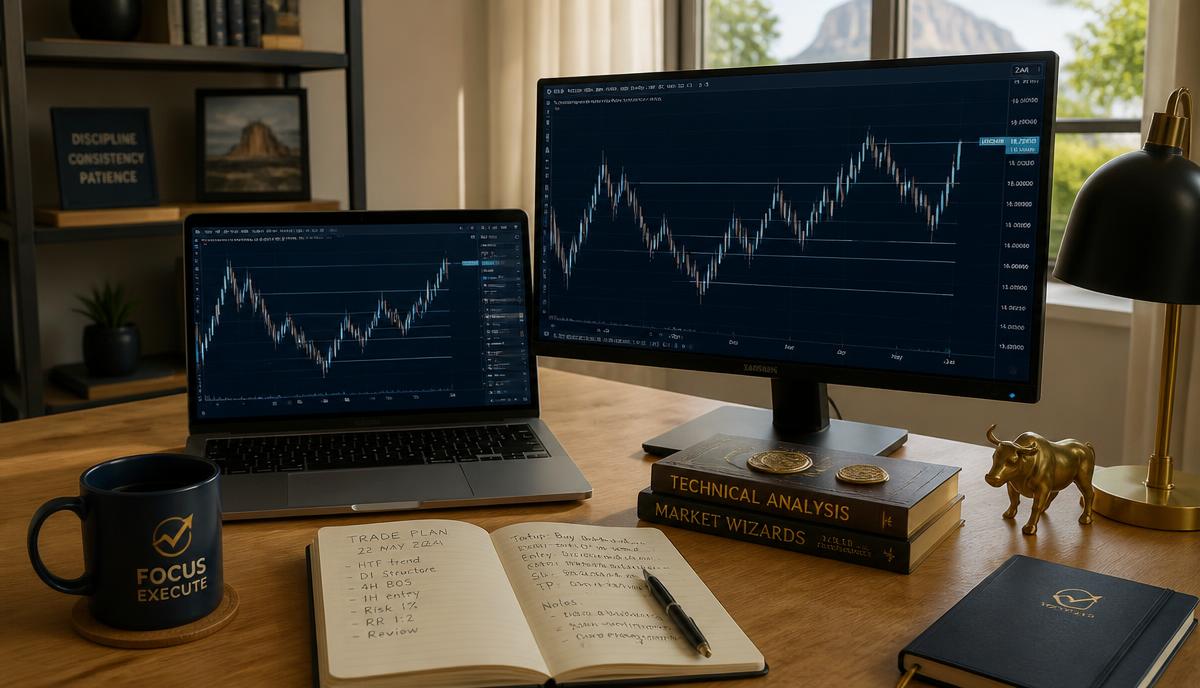
A 100 USD challenge fee feels small, so traders take it less seriously than they would their own 25,000 USD. They skip the trade journal. They trade on platforms they do not know. They take setups they would never take on their own account.
A challenge is not a lottery ticket. It is a job interview for a 25,000 USD trading desk. The traders who treat it that way pass much more often.
What Funded Traders Actually Do
Funded traders are not better at predicting markets than evaluation traders. They are better at three things:
- Position sizing — small, fixed, mechanical.
- Daily loss discipline — they stop when the rule says stop.
- Trade selection — they take fewer trades and pass on anything that does not meet the plan.
That is it. The strategy is almost beside the point.
Focus on Becoming a Better Trader First
If you have failed a challenge — or several — the problem is rarely the strategy. It is almost always one of the five mistakes above, repeated under emotional pressure.
The Prop Firm Challenge Mastery course is built around the rules that actually get traders funded — risk management, daily loss discipline, and the trade-selection framework that turns challenge fees into funded accounts. If you would rather skip the broker route entirely, TurboTrade Fund is the prop firm path we work with directly.